In short
- Apple Reference Image proves that a photo was captured by the sensor of an iPhone 18 Pro or Pro Max, and shows what has been edited since.
- In the EU you cannot capture these photos at launch. With iOS 27, iPadOS 27 and macOS 27 you can still view and compare them.
- It is one building block for trust in images, alongside labelling AI imagery. It tells you nothing about a photo that has no reference image.
What is Apple Reference Image? It is a feature of the iPhone 18 Pro and Pro Max that stores a signed reference image next to the normal photo. The reference image proves that the camera sensor of a real iPhone recorded the scene, and you can place it beside the edited photo to see what has changed. Apple announced it on 9 September 2026 (Apple, 2026).
If you work in Europe, there is an important condition. Capturing a reference image is not available in the EU at launch. Viewing and checking one is, on iPhone, iPad and Mac running the latest software. For a marketing or communications team, it is therefore mainly a way to check images you receive for now, and only later a way to prove your own images are genuine.
How does Apple Reference Image work?
Apple describes the process in four steps (Apple, 2026):
- The sensor signs. According to Apple, the new sensor in the Main camera "can sign every pixel it sees". In the new Reference mode, the camera captures signed sensor data.
- Private Cloud Compute develops. That data goes to Private Cloud Compute, Apple's secured cloud environment, which turns it into a reference image that can no longer be altered.
- Photos shows the digital negative. In the Photos app, the reference image sits next to the normal photo, "like a digital negative". You compare the two and can tell whether edits were made.
- Other apps can show it too. iOS, iPadOS and macOS 27 include APIs, interfaces for developers, so that third-party apps can display reference images.
The feature is off by default. You opt in, and you have to do so when you take the picture: according to InfoQ, an existing photo cannot be given a reference image after the fact (InfoQ, 2026).
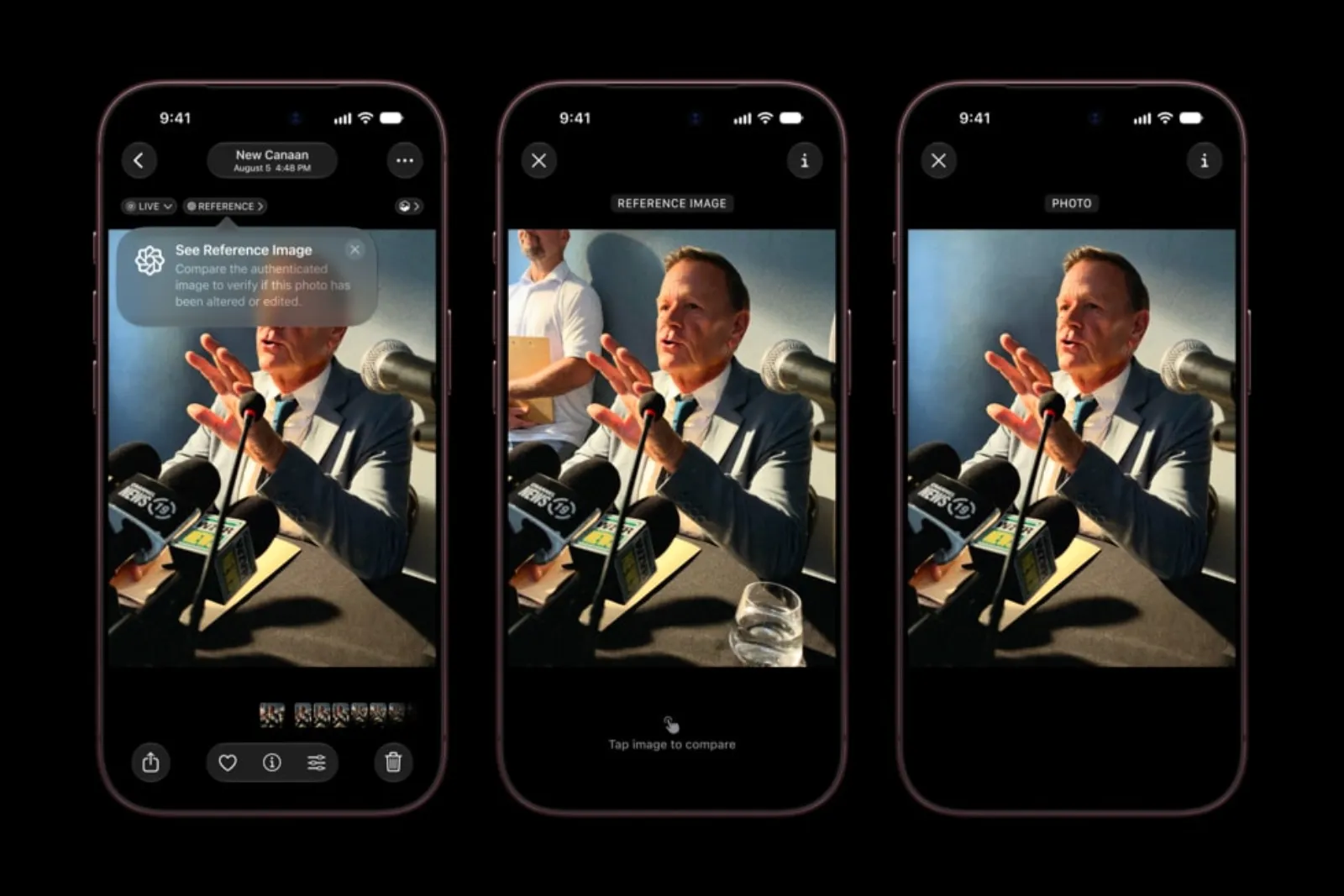
Image: Apple, Apple debuts iPhone 18 Pro and iPhone 18 Pro Max.
Apple's own example makes the point. The reference image shows a man holding a clipboard and a glass of water next to the speaker. In the normal photo, both are gone. Anyone who only sees the edited version would never know.
Nieman Lab likens it to a receipt the photographer can produce later as proof of origin. If doctored versions of a photo start circulating, a photojournalist could use the reference image to show what the sensor originally captured (Nieman Lab, 2026).
Can you use Apple Reference Image in the EU?
Partly. Apple's wording is: "In the EU, Apple Reference Image capture will not be available at launch with iPhone 18 Pro models, but users with iOS 27, iPadOS 27, and macOS 27 will be able to develop and view reference images" (Apple, 2026, footnote 5). In China, the feature is not available at all at launch.
In practice:
- You cannot create a reference image yourself with an iPhone 18 Pro in the EU.
- You can develop, view and compare a reference image that someone captured outside the EU.
Apple gives neither a reason nor a date for the EU. It does fit a wider pattern: Siri AI is not coming to the iPhone in the EU for now either. Our roundup of Apple's September 2026 announcements covers that in more detail.
How is it different from C2PA and Content Credentials?
C2PA is an open standard for provenance data, also known as Content Credentials. Nieman Lab notes that camera makers such as Nikon and Canon use it, as does Google on its Pixel phones. Apple has not signed up, and evidently believes it has a better approach (Nieman Lab, 2026).
InfoQ sets out the reasoning behind that choice (InfoQ, 2026):
- When the signing happens. C2PA attaches provenance after capture, which leaves a window between taking the picture and signing it in which the image could be changed. With Reference Image, the sensor signs straight after capture.
- The photographer's identity. C2PA can tie an image to a public identity. With Reference Image, InfoQ reports, the final image carries no photographer or device credential, because Apple's signing service signs every image.
The second point matters to anyone photographing in sensitive situations: the picture proves it is real without revealing who took it. This is InfoQ's account of Apple's design choice. Whether the approach proves stronger than C2PA in practice is too early to judge.
There is also a counterpart on the other side. Google's SynthID marks images that were made with AI. Nieman Lab sums up the difference: SynthID says "this is fake", Reference Image says "this is real". Apple says Image Playground will support SynthID in a software update later this year (Apple, 2026).
What does a marketing team get out of it?
Three uses, from available today to later on.
1. Checking images from others. You receive a photo from a partner, a creator or a news source and want to know whether it holds up. If a reference image comes with it, you can compare the two yourself, even in the EU. Suppose a supplier sends a photo of a product launch for your press release. Ask for the reference image as well and put them side by side before you publish.
2. Proving your own images are real. Product shots, event coverage and news images can be questioned now that AI imagery is increasingly hard to tell from the real thing. A reference image lets you show that a shot is genuine. Teams in the EU cannot do this with their own handsets at launch. Suppose you have a colleague or photographer outside the EU: they can capture the reference image, and you can view it here.
3. Labelling your own AI imagery. The reverse obligation still applies. If you create realistic images with AI, a label may be required. What the AI Act says about this, and when you need to label, is covered in EU AI Act 2026: a delay for high risk, not for transparency. Reference Image does not change any of that.
A practical step for now: set out in your image guidelines when you ask for proof of origin, which images you label yourself, and who checks.
Where does the proof stop?
Reference Image is strong at what it does, but it does only one thing. Keep these limits in mind:
- iPhone 18 Pro and Pro Max only. Photos from other phones or cameras have no reference image.
- Only if it was switched on. The feature is opt-in and must be chosen at the moment of capture.
- No capture in the EU at launch.
- Absence proves nothing. A photo without a reference image is not fake for that reason. Most genuine photos will not have one.
- Real is not the same as honest. The reference image proves what the sensor saw. It does not prove that the scene itself was not staged.
Proof of origin, AI labels and human review therefore complement each other. None of them solves the trust problem on its own.
Where to go from here
If your team already uses AI a lot for content and campaigns, the in-company workshop AI for marketers helps you do that with your own brand and guidelines. Want to work out how to build image checks into your own content process? Book a conversation.
Sources
- Apple (9 September 2026). Apple debuts iPhone 18 Pro and iPhone 18 Pro Max.
- Apple (14 September 2026). Major updates for Apple's software platforms are now available.
- Nieman Lab, Joshua Benton (9 September 2026). Apple launches a new way to prove a photo was shot with an iPhone (not generated by AI).
- InfoQ, Steef-Jan Wiggers (24 September 2026). Apple Reference Image Signs Photos at the Sensor, Moving Provenance Trust away from C2PA.