In short
- AI hits knowledge work hardest: according to DNB, about a quarter of Dutch workers have an occupation in which AI can speed up at least half of the tasks. That usually does not mean the job disappears, but that the work shifts from making things yourself to steering, checking and deciding.
- There are also genuinely new roles, such as people who build AI agents or automate processes with AI. They are still few in number and some are an existing job with a new label.
- What this means in your company depends on what you choose: does AI replace tasks or complement your people? Pick one process, have a person approve and decide in advance where the freed-up time goes.
Will AI make jobs disappear? Knowledge work is hit hardest. According to DNB, the Dutch central bank, that applies to about a quarter of Dutch workers, mostly in occupations where information is processed, analysed or written, such as software developers, linguists and accountants. That is a measure of what AI can speed up, not a forecast of jobs lost. Repetitive parts of the work are taken over, many roles change and new ones appear. Whether that costs jobs overall is uncertain and depends largely on what you choose as an employer.
Which jobs will AI replace? Knowledge work is hit hardest
In November 2026, DNB calculated that this applies to a quarter of workers. At a threshold of 40 per cent of tasks, it is half. A Microsoft study of 200,000 real Copilot conversations shows the same, and Microsoft itself says this does not mean an occupation disappears.
So what actually happens to jobs? In August 2026, using payroll data on millions of Americans, Stanford found no evidence of widespread job losses. But employment of 22 to 25-year-olds in the most exposed occupations is about 19 per cent lower than for comparable young people elsewhere, while experienced workers show no such gap. It is a matter of less hiring, not more dismissals, and mostly in occupations where AI substitutes for tasks. Where AI complements workers, employment is flat or rising. The researchers call it an early signal, not a proven cause.
The evidence is not clear-cut. In an analysis published by the World Economic Forum, LinkedIn says that outside clinical healthcare, hiring patterns look the same for jobs with high and low AI exposure. In the Netherlands, Rabobank research in ESB (in Dutch) found less work for young people in occupations that compete with generative AI, but other researchers attribute that partly to higher interest rates. In the US, in the most exposed occupations (including software, data, marketing and finance), Indeed sees the share of entry-level postings fall from 29 per cent in 2021 to 10 per cent in 2026 (Indeed).
And the companies themselves? Rabobank (in Dutch) asked more than 1,300 companies: among those that use AI, 18 per cent saw more staff because of AI over the past three years and 6 per cent fewer. Those expecting a decline cite automation of administration and less demand for customer contact, support, junior and software roles.
What changes in your job?
Do you recognise yourself or your team? Mind the difference in evidence: some sources measure, others ask about expectations.
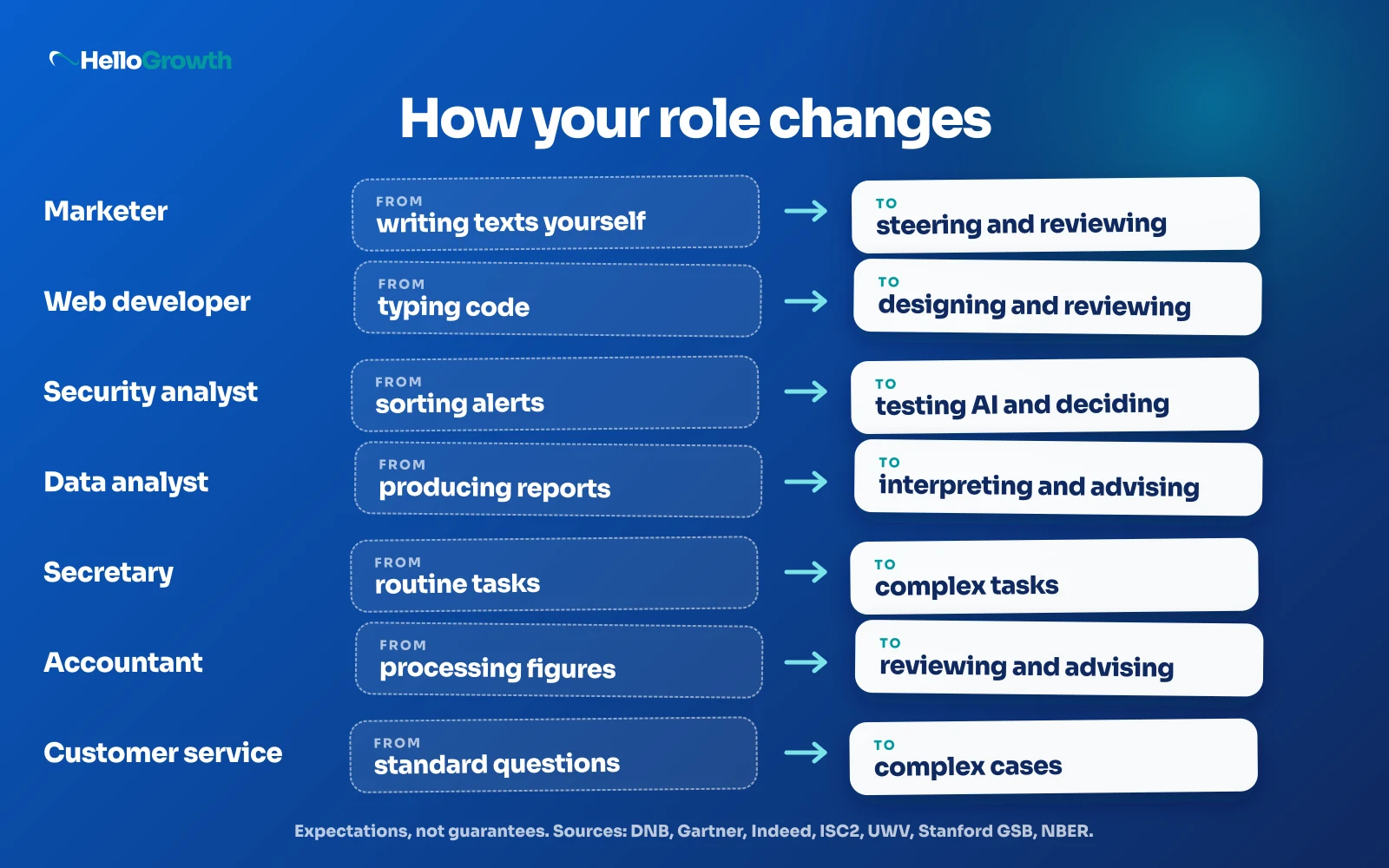
Image: Hello Growth, own illustration based on the sources cited (labels in English). Expectations, not guarantees.
- Marketer and content maker. AI produces first drafts, translations and reports. The person chooses the audience, reviews and steers. 91 per cent of 282 executives expect AI to do at least a quarter of CMO responsibilities within two years (Gartner, November 2026, an expectation).
- Web developer and software engineer. Routine code is taken over, designing and reviewing grows. In the US, software job postings have risen almost 15 per cent since February 2025 but are still 27.5 per cent below pre-pandemic levels. Of the rise between May 2025 and May 2026, 71 per cent is senior roles (Indeed Hiring Lab).
- Security. AI takes over part of first-line triage. Checking and deciding when to trust AI becomes bigger work: 65 per cent of the security professionals surveyed spend more time on it and 89 per cent received wrong AI recommendations (ISC2, 856 AI users, experiences).
- Data analyst. Indeed counts data and analytics among the most exposed occupations. Our expectation, not a measurement: the work moves from producing reports to interpreting and advising.
- Secretary and executive assistant. In the Netherlands, the share of vacancies for administrative jobs with few complex tasks fell from 57 per cent in 2019 to 48 per cent in 2024, while complex ones rose from 24 to 31 per cent (UWV, January 2025, in Dutch). That is about automation in general, not only AI.
- Accountant and finance employee. AI users close the books 7.5 days faster and spend 8.5 per cent less time on routine processing (Stanford GSB, survey of 277 accountants). Reviewing and advising stays with the person.
- Customer service. Across 5,179 agents, AI assistance resolved 14 per cent more issues per hour, 34 per cent for beginners and barely any for experienced agents (NBER). Of 321 service leaders, 85 per cent add tasks to the agent role and 31 per cent make or plan dismissals (Gartner, 2026, intentions).
We see it in our own work too. At a European supplier of fitness equipment, AI writes and translates 82 text fields per product in six languages, while an editor reads along, adjusts and approves and the team steers the AI itself (the case). The work moves from writing to editing and steering. How much time that saves is not stated on the case page, so we do not say either.
Which new jobs does AI create?
What is genuinely new is mostly roles where companies build, set up and run AI. According to the World Economic Forum, LinkedIn counts 1.3 million new AI roles in two years worldwide, such as AI engineers, forward deployed engineers and data annotators, and more Head of AI roles.
- AI engineer and agent builder: builds AI applications and agents and connects them to business systems. Dutch vacancies are advertised on job sites, including at Wolters Kluwer.
- Forward deployed engineer: works at the client and adapts AI to its workflows. Demand grows fast from a small base: in the US about 200 postings in 2024 and more than 5,200 in the first seven months of 2026 (Lightcast). We found hardly any in the Netherlands.
- AI automation specialist: automates business processes with AI. On 17 November 2026, for example, Envalior in Geleen was looking for a Senior People Intelligence, Automation & AI Specialist.
- AI product owner and AI governance: there are confirmed Dutch vacancies at Fuse Energy and Wortell, though some of it is an existing role with an AI label. According to the European Commission, the AI Act does not require a dedicated AI officer.
- AI growth manager: on 25 November 2026 there were adverts such as Legal AI Growth Manager (Saga, Amsterdam) and Senior Growth Marketing Manager with an AI focus (AIHR, Rotterdam). Our description: someone who connects marketing, data and AI to a growth goal, chooses which processes AI handles, keeps track of what it delivers and makes sure a person approves what goes out. Our expectation, not a measurement: you rarely find that combination in one person, which is why it appears as a role of its own.
The caveat: the title prompt engineer is fading, while the skill stays. New AI roles are still few in number. An analysis of more than 17,500 job adverts (HackerNoon, November 2026, in Dutch, described by its author as AI-assisted) found the share of adverts with AI in the title stable at about 6 in 100, and most AI roles outside engineering are ordinary jobs in marketing, product or sales with one extra task: bringing AI into the company. The vacancies above come from our own search on job sites. Only those at Envalior, Wortell and Fuse Energy are confirmed with the employer.
What does this mean for your team?
Your team probably already uses AI. Of people with paid work, 43 per cent use AI in their job (CBS, in Dutch), and about 70 per cent of the Dutch companies surveyed use AI (Rabobank). Among companies that work most intensively with AI, 75 per cent expect a change in the number or type of employees. They feel it first. Our conviction, not a measurement: whoever learns now how AI fits into a work process keeps the choice in their own hands.
- Pick one recurring process and measure beforehand how much time it takes. How to make that choice is covered in AI strategy and AI roadmap: choose what fits, not what is hyped.
- Design AI as a complement, not a replacement. Where AI complements workers, employment is flat or rising according to Stanford.
- Involve the people who do the work. DNB advises employers to involve their employees early. How to arrange that in a way you can demonstrate is covered in AI literacy in your organisation.
- Decide where the freed-up time goes. DNB mentions improving quality, developing new products or producing more.
- Look at your starters. In customer service and accountancy, beginners benefit most from AI, but the entry-level work itself changes. Think about how new people learn the trade.
When does this apply less?
Exposure is not job loss. The measure used by DNB and Microsoft shows where AI can speed up tasks, not what happens to the number of jobs. Many figures come from the United States, from surveys of a particular group or are about expectations, and the research on starters contradicts itself. We do not give a forecast per occupation: none of the sources can do that reliably.
Sources
- DNB, AI biedt kansen voor Nederland, maar succes komt niet vanzelf (AI offers opportunities for the Netherlands, but success does not come by itself), 2 November 2026
- Microsoft Research, Working with AI, July 2025
- Stanford Digital Economy Lab, Canaries in the Coal Mine?, August 2026
- World Economic Forum, AI has already added 1.3 million new jobs, according to LinkedIn data, 15 January 2026
- ESB, Dalende werkgelegenheid onder Nederlandse jongeren die concurreren met GenAI (Falling employment among Dutch young people who compete with GenAI) and Niet zeker dat werkgelegenheid onder Nederlandse jongeren daalt door GenAI (Not certain that employment among Dutch young people falls because of GenAI), 2026
- RaboResearch, Leidt AI tot minder banen? Bedrijven verwachten vaker het tegenovergestelde (Does AI lead to fewer jobs? Companies more often expect the opposite), November 2026
- CBS, AI in de samenleving: ervaringen en opinies (AI in society: experiences and opinions), 2026
- Gartner, Survey finds 91 percent of C-level executives expect AI to perform at least 25 percent of CMO responsibilities, 19 November 2026
- Indeed Hiring Lab, AI and job postings: from destruction to creation, 8 July 2026, and AI exposure isn't squeezing advertised pay, 17 September 2026
- ISC2, AI Pulse Survey 2026, 14 July 2026
- UWV, Administratieve beroepen hard geraakt door automatisering (Administrative occupations hit hard by automation), 21 January 2025
- Stanford GSB, AI is reshaping accounting jobs by doing the boring stuff, 26 June 2025
- NBER (Brynjolfsson, Li and Raymond), Generative AI at Work, 2023
- Gartner, Survey finds 85 percent of service and support leaders are expanding human agent responsibilities, 28 April 2026
- Lightcast, Forward deployed engineer: the AI job, 2026
- European Commission, AI literacy: questions and answers, updated 20 October 2026
- HackerNoon (Maria Atamanova), Is AI echt nieuwe banen aan het creëren? Data uit 12 landen (Is AI really creating new jobs? Data from 12 countries), 18 November 2026