In short
- According to OpenAI, GPT-6.1 Sol comes close to GPT-6 Astra at a fifth of the price. For most business use through the API, it is the model to test first.
- Ultrafast makes Astra up to six times faster in the API, at six times the price. It does not run on European servers.
- The Agents API gained computer use: an agent operates a browser. European data residency and Zero Data Retention are not available there.
At DevDay on 29 September, OpenAI announced a new model, a faster price tier and new capabilities for agents. If you use AI in your own software or processes, GPT-6.1 Sol is the most useful of the three: close to the top model's quality at a fifth of the price, and usable with European data residency. For Ultrafast and the Agents API the opposite holds: powerful, but processed outside Europe.
Below, per announcement: what was launched, what it costs and what it means if your data has to stay in Europe.
GPT-6.1 Sol: nearly Astra, at a fifth of the price
GPT-6.1 Sol is an upgrade of GPT-6 Sol, which came out a week earlier. OpenAI says it "nearly matches GPT‑6 Astra's intelligence on agentic coding, computer use, and professional work at one-fifth of Astra's standard input and output token prices" (OpenAI, Introducing GPT-6.1 Sol). That is OpenAI's claim, based on its own benchmarks; there are no independent measurements yet.
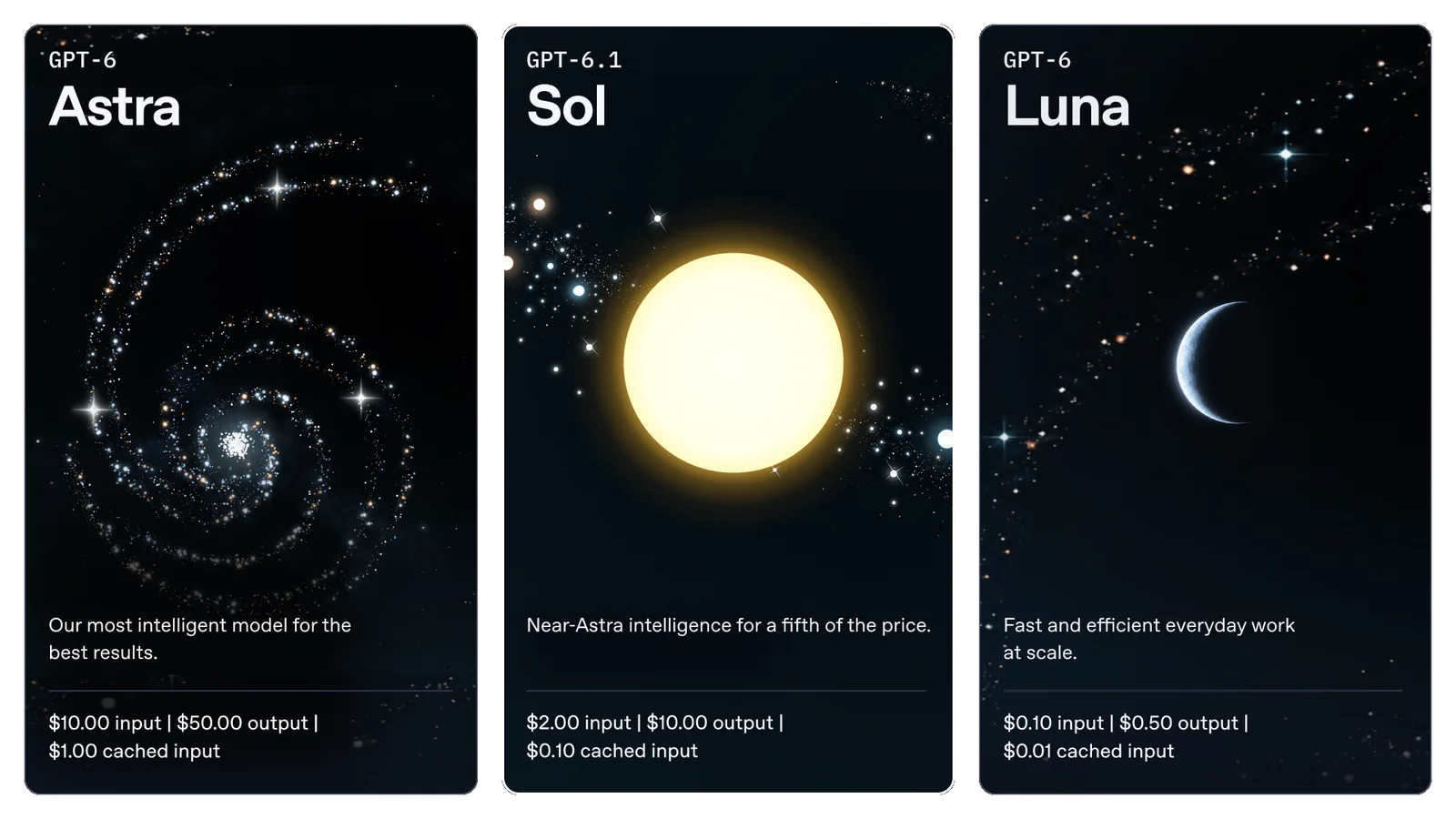
Image: OpenAI, Introducing GPT-6.1 Sol.
API prices per million tokens (OpenAI API Pricing):
| Input | Cached input | Output | |
|---|---|---|---|
| GPT-6 Astra | 10 dollars | 1 dollar | 50 dollars |
| GPT-6.1 Sol | 2 dollars | 0.10 dollars | 10 dollars |
A fictional example: suppose an application processes 100 million input tokens and 20 million output tokens a month. With Astra that costs 2,000 dollars, with Sol 400 dollars. If you reuse a lot of the same context, such as a fixed instruction or a product catalogue, the low price for cached input saves even more.
Availability: in the API, in Codex and in ChatGPT Work, for Plus, Pro, Business, Enterprise and Edu. It is not yet in regular ChatGPT chat. OpenAI's recap is less precise about this than the announcement itself.
Ultrafast: faster, but not in Europe
Ultrafast is a faster price tier. OpenAI promises "up to 8× faster token generation (300 tokens per second) in Codex and up to 6x in the API" (OpenAI, DevDay 2026 Recap). The documentation's subtitle says up to eight times, so treat the numbers with care.
GPT-6 Astra Ultrafast costs six times the standard price: 60 dollars per million input tokens and 300 dollars per million output tokens. GPT-6.1 Sol Ultrafast is "coming soon". In ChatGPT, Ultrafast comes with the new Pro 500 plan (500 dollars a month) and with Enterprise.
The key point for a European business is in the documentation: "Ultrafast supports US data residency and global processing only. It does not support EU or other non-US regional processing endpoints" (OpenAI, Ultrafast mode). In ChatGPT too, workspaces that require processing outside the US are not eligible.
Speed matters most when a person is waiting, such as in a customer conversation or with an agent that takes many small steps. For background work, such as updating product copy overnight, you pay six times as much for something nobody notices.
Agents API: now with a browser
The Agents API is a managed environment in which OpenAI runs agents for you, built on the same technology as Codex. The API itself has existed since 10 September. What is new at DevDay is computer use: the agent operates a browser hosted by OpenAI (OpenAI API changelog).
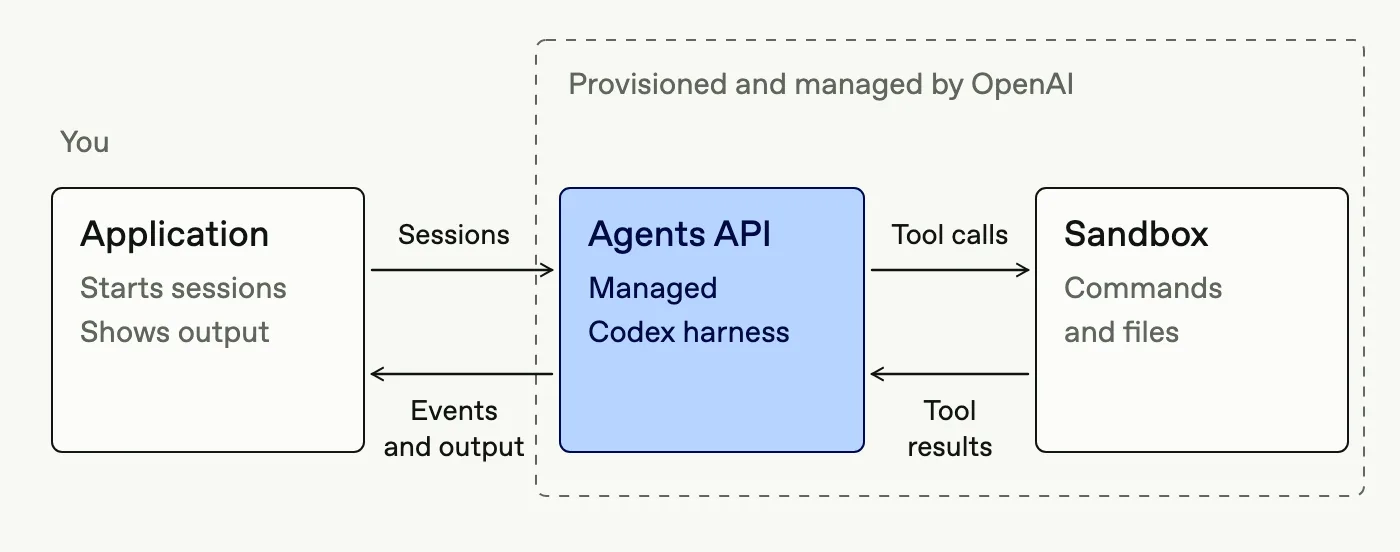
Image: OpenAI, Agents API.
There is no extra charge for the API itself; you pay for the tokens and tools your agents use. Three points from the computer use documentation (OpenAI, Computer use):
- The browser asks for approval before each new website, public ones included.
- That approval does not apply per action. For purchases or irreversible actions you need to restrict the browser yourself.
- "Treat website content as untrusted": a web page can contain instructions that lead the agent astray.
And the limitation that matters in Europe: "The Agents API currently supports data residency only in the United States and does not support Zero Data Retention (ZDR)" (OpenAI, Agents API). If you process personal data of customers or staff, that is a reason not to build on it yet.
Private Intelligence: more control over your data
With Zero Data Retention (ZDR), OpenAI does not store your data. What is new is Private Safety Processing: the safety checks OpenAI runs on requests then happen in a sealed environment, without OpenAI staff being able to see the content. The data is stored encrypted in the customer's own storage at AWS, Azure or Google Cloud, which can be in a European region (OpenAI, Private Safety Processing). You need ZDR approval first. A further step, Private Inference, follows as a preview this autumn.
What can you use in Europe?
| Announcement | European processing |
|---|---|
| GPT-6.1 Sol via the API | Yes, with Standard, Flex and Batch; not in Fast mode. 10% surcharge, approval required. |
| Ultrafast | No, US or global only |
| Agents API, including computer use | No, US only; no ZDR |
| ZDR with Private Safety Processing | Yes, storage in an EU region possible |
Sources: OpenAI, Your data and the documentation above.
What this means for your choice
If you currently use GPT-6 Astra in your own application, test GPT-6.1 Sol on your own tasks. Take twenty to fifty real examples, run them through both models and compare the results. If Sol is good enough, you pay a fifth. We covered which model suits which work in ChatGPT or Claude?
For Ultrafast and the Agents API, the first question is where your data may be processed, and only then whether it fits technically. If you plan to use agents, also read Using AI agents safely: five questions to ask first.
What is still unclear?
The Ultrafast documentation mentions a preview for "GPT-5.6 Sol", while the announcements talk about GPT-6.1 Sol. The Decisions API, a fast way to have AI make fixed choices for classifying or routing, is in limited preview without documentation or pricing. And the 45% faster first response mentioned in the keynote does not appear in the documentation. Hold off on plans that depend on these points until OpenAI spells them out.
The full DevDay overview is in OpenAI DevDay 2026: what it means for your business.
Want to know which model and set-up fit your application and your data requirements? Book a conversation.
Sources
- OpenAI, Introducing GPT-6.1 Sol, 29 September 2026
- OpenAI, DevDay 2026 Recap, 29 September 2026
- OpenAI, API Pricing
- OpenAI, Ultrafast mode
- OpenAI, Agents API and Computer use
- OpenAI, API changelog
- OpenAI, Your data
- OpenAI, Private Safety Processing